Kimi-K3's Frontend Win Complicates the U.S.-China AI Narrative
A2Agent Team · 2026-07-21T00:00:00Z
Arena.ai's chart, titled Frontend Code Arena: United States vs China, captures a narrow but important moment in the AI race. The headline is clear: Kimi-K3, a Chinese model, reaches an Arena Score of 1,679 and appears to overtake leading U.S. models in frontend coding. Claude Fable 5 is shown at 1,631, while several Claude, Gemini, GPT, GLM, DeepSeek and MiniMax models mark the path that led to this point.
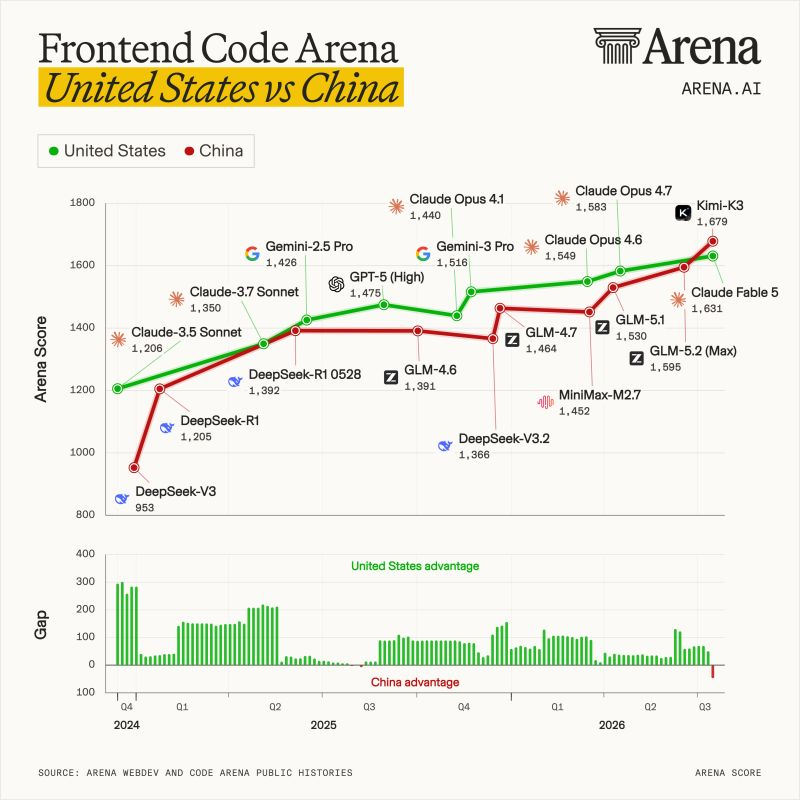
The chart should not be read as proof that China has surpassed the United States across artificial intelligence as a whole. It measures a specific category: frontend code generation. That means web interfaces, HTML, React-style development, visual implementation, data dashboards and interactive product surfaces. These are important commercial tasks, but they are not the same as broad reasoning, scientific discovery, backend architecture, cybersecurity, long-horizon software maintenance or enterprise deployment reliability.
Still, the shift matters. For most of 2024 and 2025, the bottom panel shows a consistent U.S. advantage. The green bars suggest that American models held the lead in this benchmark for a long period. Chinese models such as DeepSeek-V3, DeepSeek-R1, DeepSeek-R1 0528 and GLM gradually moved closer, but the overall gap remained in favor of the United States. Kimi-K3 changes the visual story: at the far right of the chart, the gap turns red, indicating a China advantage.
The most important signal is not simply that one model scored higher. It is that the frontier is becoming more crowded. A benchmark once dominated by U.S. labs now shows credible competition from Chinese developers. That competition appears not as a vague promise, but as a measurable result in a practical software category.
For American AI companies, this is a warning but not a defeat. U.S. labs still hold major advantages in distribution, developer trust, enterprise relationships, product polish, cloud partnerships and integration with professional coding tools. A model that tops one leaderboard must still prove itself in real projects: handling messy codebases, following team conventions, passing tests, maintaining security, reducing hallucinated code and staying reliable under production workloads.
For Chinese AI companies, the challenge is different. Kimi-K3's score gives them visibility and credibility, but benchmark leadership must translate into sustained adoption. International users will care about speed, uptime, documentation, data governance, pricing, model transparency and legal risk. Winning a chart is valuable; becoming a default tool in global engineering teams is harder.
The broader lesson is that AI capability may be commoditizing faster than expected. If strong models from multiple countries can compete near the frontier, the market will shift from asking "Which lab has the smartest model?" to asking "Which model is useful, affordable, available and trustworthy for this task?" In software development, that question is often more practical than ideological.
The chart therefore deserves a careful interpretation. It does not settle the AI race. It does show that the race is no longer one-sided in every visible domain. In frontend coding, at least, Chinese models have moved from chasing the leaders to challenging them directly. That alone is enough to make the industry pay attention.