MiniMax M3.1 Flash: Frontier Agent Scores at Flash Prices, Now on A2Agent
A2Agent Team · 2026-10-19T00:00:00Z
MiniMax released M3.1 Flash on October 19, 2026. It's the company's new Flash model, built for agents: business automation, long coding tasks, computer use and security work. MiniMax says it runs nearly three times faster than its predecessor and cuts the cost of agent tasks by 70%. It's live on A2Agent now, at half of MiniMax's own price.
An early version ran anonymously as "Space Bunny" and processed more than 200 trillion tokens before the launch.
Quick answer
- Official price, per million tokens: $0.15 input, $0.60 output, $0.015 cached input
- On A2Agent: $0.075 input and $0.30 output per million tokens
- Speed: 200+ tokens per second in everyday use, with a median (P50) above 170
- Best score in MiniMax's comparison table on Automation-Bench (62.2) and LOCA-Bench 256K (60.3), and tied with Claude Opus 5 on BankerToolBench (76.2)
- On Automation-Bench, the max-effort setting scores 62.8% for under $0.05 a task, while Opus 5.5 scores about 57% at close to $1
- Open weights are coming later, along with a larger Pro model
Benchmarks
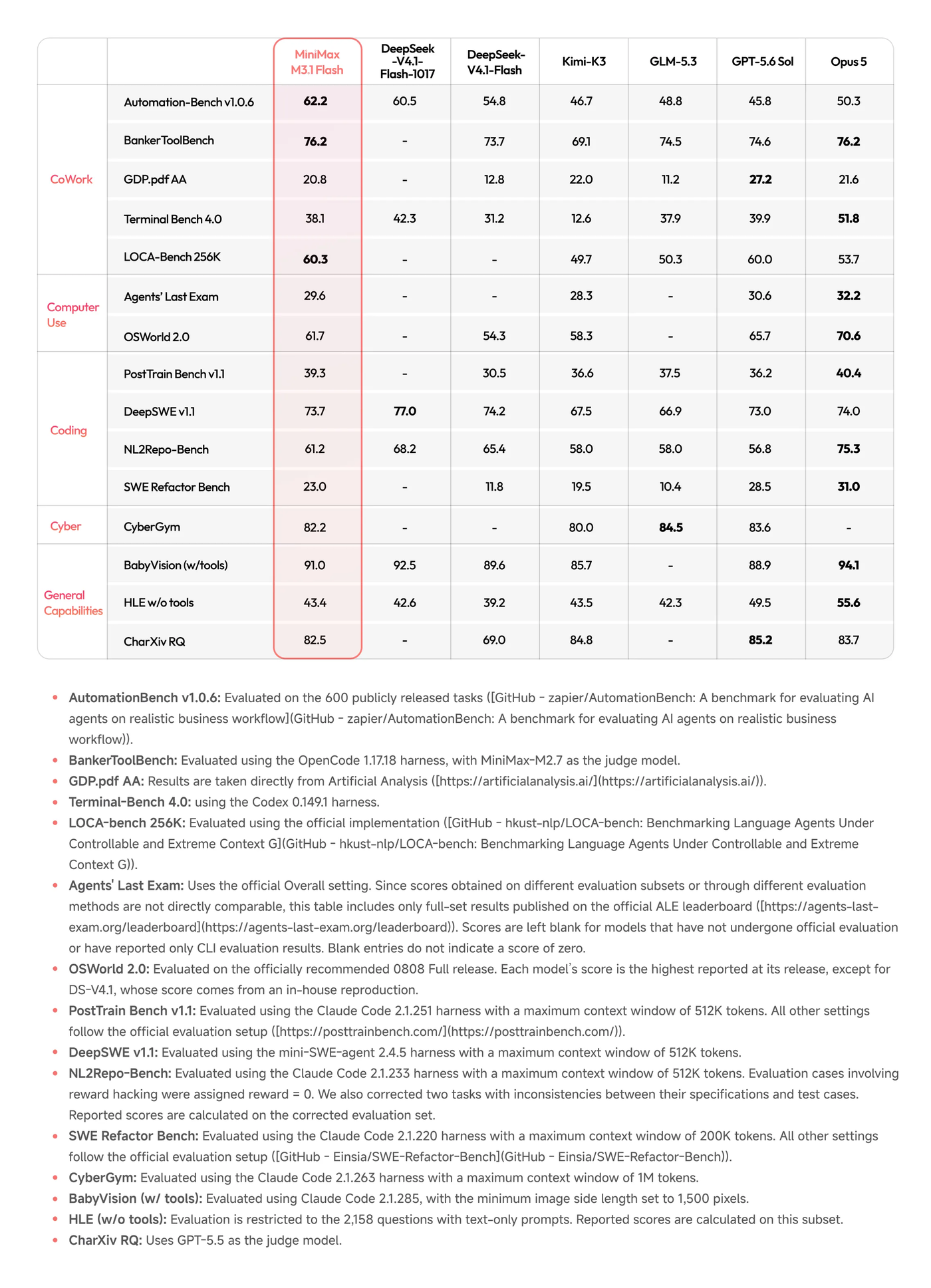
MiniMax tested M3.1 Flash against six other models. Here's how it lines up with the strongest closed model in the table, Claude Opus 5, and the other new Flash model this week, DeepSeek V4.1 Flash 1017:
| Benchmark | M3.1 Flash | DeepSeek V4.1 Flash 1017 | Claude Opus 5 |
|---|---|---|---|
| Automation-Bench v1.0.6 | 62.2 | 60.5 | 50.3 |
| BankerToolBench | 76.2 | n/a | 76.2 |
| LOCA-Bench 256K | 60.3 | n/a | 53.7 |
| Terminal-Bench 4.0 | 38.1 | 42.3 | 51.8 |
| Agents' Last Exam | 29.6 | n/a | 32.2 |
| OSWorld 2.0 | 61.7 | n/a | 70.6 |
| PostTrain Bench v1.1 | 39.3 | n/a | 40.4 |
| DeepSWE v1.1 | 73.7 | 77.0 | 74.0 |
| NL2Repo-Bench | 61.2 | 68.2 | 75.3 |
| CyberGym | 82.2 | n/a | n/a |
| BabyVision (with tools) | 91.0 | 92.5 | 94.1 |
| HLE (no tools) | 43.4 | 42.6 | 55.6 |
The strongest results are in "CoWork", MiniMax's name for real business workflows. M3.1 Flash has the top Automation-Bench score in the table, ahead of DeepSeek, GPT-5.6 Sol and Opus 5, and the top LOCA-Bench 256K score for long-context agent work. It matches Opus 5 on BankerToolBench, which tests multi-step financial tasks. On OSWorld 2.0 (61.7) and Agents' Last Exam (29.6) it beats Kimi K3, though Opus 5 and GPT-5.6 Sol still score higher.
Coding is close to the top tier without leading it. DeepSWE v1.1 at 73.7 sits within a point of Opus 5 and GPT-5.6 Sol, and PostTrain Bench at 39.3 is within about a point of Opus 5. On CyberGym, M3.1 Flash scores 82.2, behind GLM-5.3 (84.5) and GPT-5.6 Sol (83.6).
Cost per task
MiniMax published three charts that plot score against what each task actually costs.
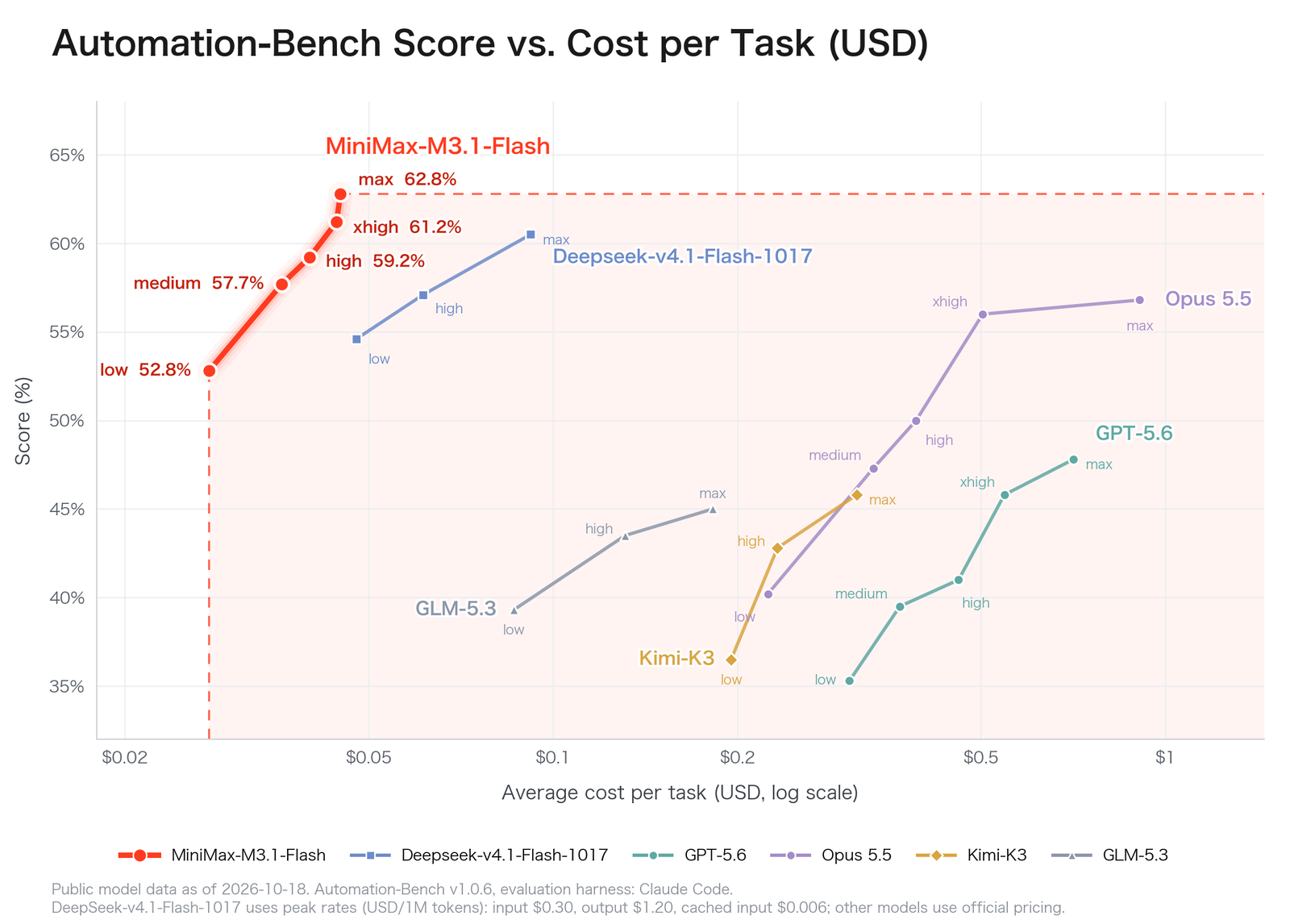
Automation-Bench is the clearest case. Every effort setting of M3.1 Flash costs under about $0.05 a task, and max effort reaches 62.8%. DeepSeek V4.1 Flash 1017 tops out at 60.5% for roughly $0.09 a task at DeepSeek's peak rates. Opus 5.5 reaches about 57% at close to $1 a task, and GPT-5.6 about 48% at around $0.70.
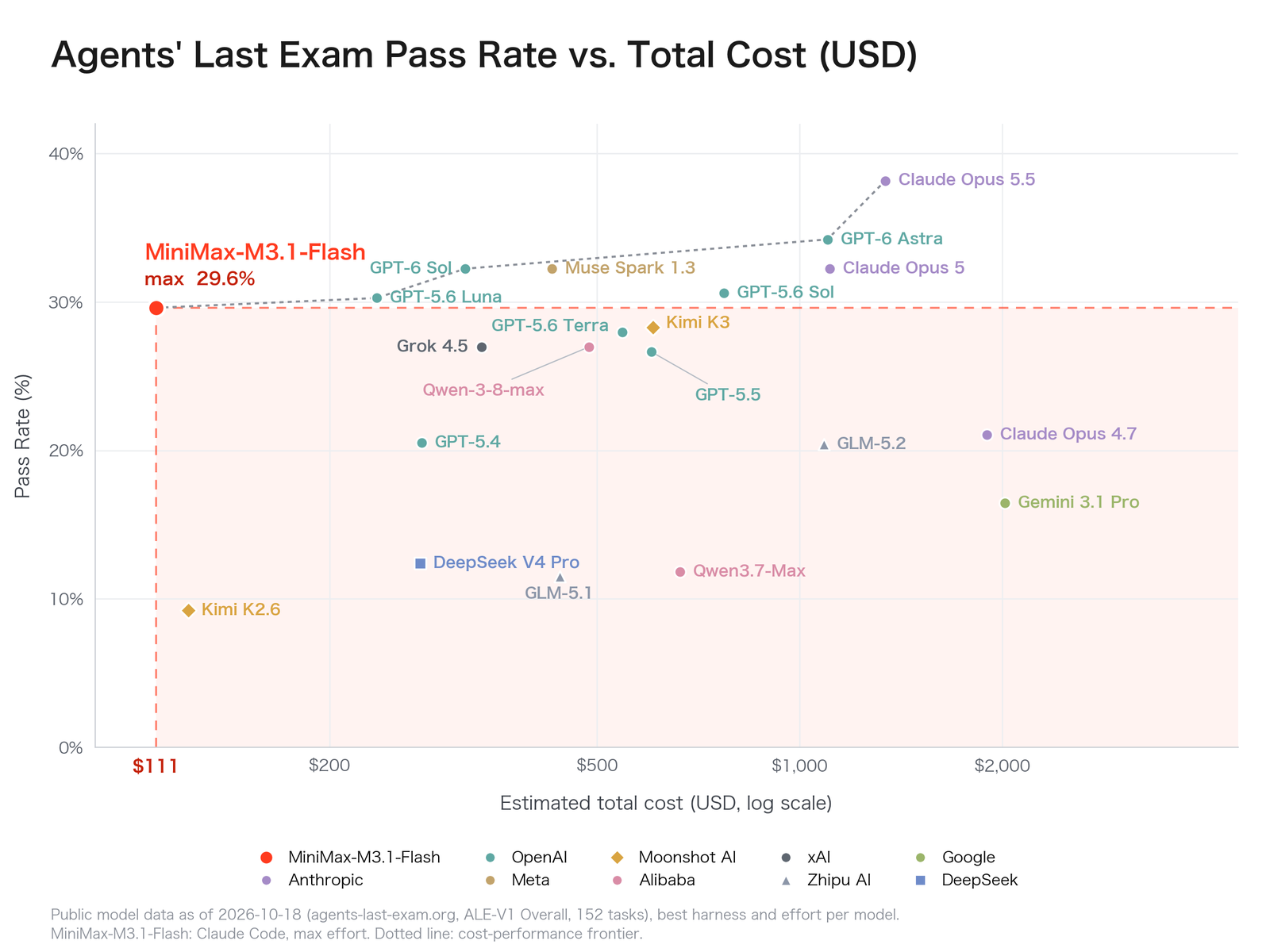
On Agents' Last Exam, M3.1 Flash at max effort passes 29.6% of the 152 tasks for an estimated $111 in total, the lowest cost of any model on the chart. GPT-5.6 Luna scores about the same for roughly twice the cost, and the models that score higher, such as GPT-6 Astra and Claude Opus 5.5, cost around ten times as much.
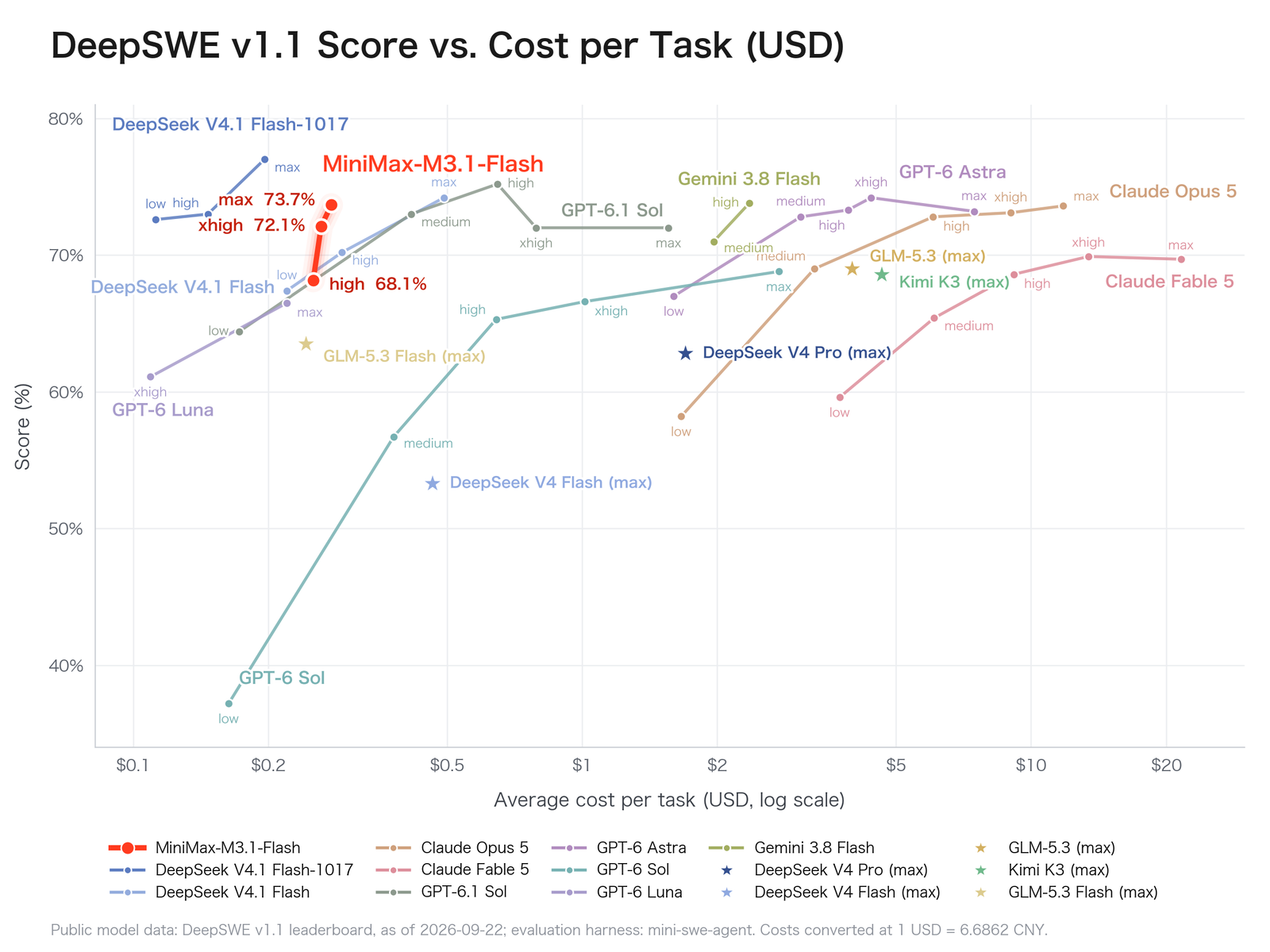
On DeepSWE, M3.1 Flash scores 68.1% to 73.7% depending on effort, at roughly $0.25 to $0.28 a task. That's a fraction of what GPT-6 Astra or Claude Opus 5 cost for similar scores. DeepSeek V4.1 Flash 1017 does better on this one benchmark, at 77.0% for about $0.20, so for pure coding loops it's worth trying both.
Speed and price
In everyday use M3.1 Flash generates more than 200 tokens per second, with a median above 170. MiniMax credits more aggressive sparsity in inference for the speed-up, and says agent tasks now cost 70% less overall than on its predecessor.
MiniMax's API prices:
| Per million tokens | |
|---|---|
| Input | $0.15 |
| Cached input | $0.015 |
| Output | $0.60 |
What it's built for
MiniMax points M3.1 Flash at five kinds of work:
- Business automation across SaaS tools in sales, marketing, operations, customer service, finance and HR
- Finance and document work that needs multi-step planning, consistency across files and chained tool calls
- Long software tasks such as building features, fixing bugs and running tests
- Computer use in real environments over long sequences of actions
- Security work, including code audits, vulnerability patching, penetration testing, malware analysis and reverse engineering
Open weights are coming later, MiniMax says, along with a higher-end Pro model. Today you can use M3.1 Flash through the MiniMax API, the M Plan subscription and the MiniMax Code desktop app, or through A2Agent.
Use it on A2Agent
M3.1 Flash is live on A2Agent at $0.075 per million input tokens and $0.30 per million output tokens, half of MiniMax's own price. It works with the same API key as every other model on A2Agent.
With the OpenAI SDK:
from openai import OpenAI

client = OpenAI(
    api_key="YOUR_API_KEY",
    base_url="https://api.a2agent.me/v1",
)

response = client.chat.completions.create(
    model="minimax-m3.1-flash",
    messages=[{"role": "user", "content": "Hello"}],
)

print(response.choices[0].message.content)
To use it in Claude Code, set ANTHROPIC_BASE_URL to https://api.a2agent.me and ANTHROPIC_MODEL to minimax-m3.1-flash. The Models page has current prices for every model. New accounts get $5 in free credit, so you can sign up and try M3.1 Flash on your own agent tasks today.
Sources
- MiniMax M3.1 Flash (MiniMax blog)
- A2Agent on X
- A2Agent Models