Mistral Large 4 vs Kimi K3.1 Pro: Performance, Coding, Speed and API Cost
A2Agent Team · 2026-11-04T00:00:00Z
Kimi K3.1 Pro beats Mistral Large 4 on almost every shared benchmark. On LLMBenchmark.ai, which collects public leaderboards, Kimi wins 28 of the 32 boards where both models have a result, and Mistral wins 4.
Still, Mistral costs a fraction as much per token and generates output about five times faster, and its weights are already public. Which one you should use depends on the job, so this post goes through intelligence, coding, context, speed and price in turn.
At a glance
| Kimi K3.1 Pro | Mistral Large 4 | |
|---|---|---|
| Developer | Moonshot AI | Mistral AI |
| Architecture | Mixture-of-experts, 2.8T total / 104B active | Mixture-of-experts, 1.05T total / 52B active |
| Context window | About 1M tokens | About 1M tokens |
| Weights | Promised by November 4; listed as proprietary by Artificial Analysis as of writing | Released October 29 under the Mistral Ecosystem Open-Weight License |
| Input / output per 1M tokens | $2.00 / $10.00 | $0.70 / $2.10 |
| Cached input per 1M tokens | $0.20 | $0.07 |
| AA Intelligence Index v5.0 | 46 | 26 |
| Output speed (first-party API) | 31.2 tokens/s | 170.1 tokens/s |
Benchmark wins
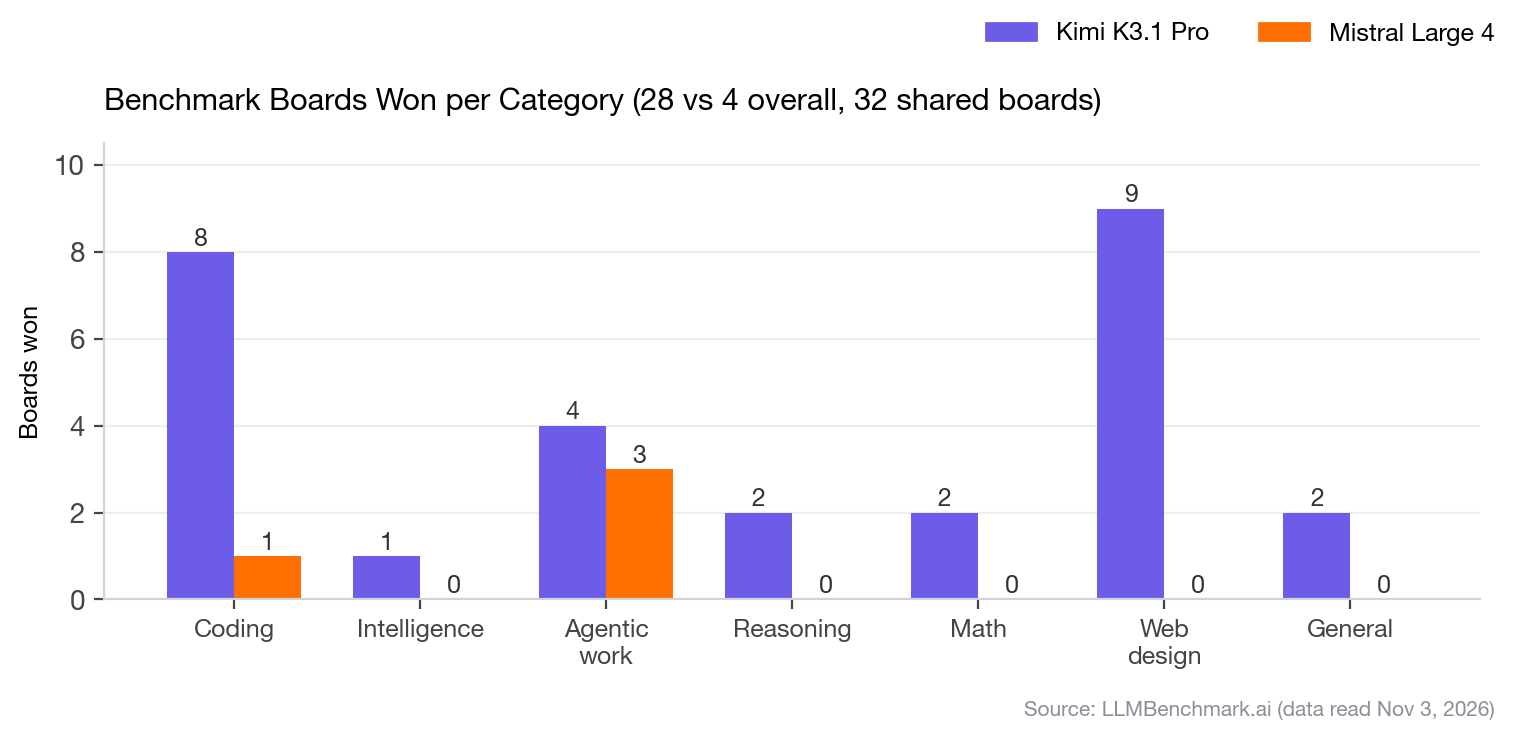
Kimi's lead is widest in web design (9 to 0) and coding (8 to 1). Agentic work is the only close category, at 4 to 3, and it's where three of Mistral's four wins come from.
Architecture and deployment
Both are mixture-of-experts models, which run only a slice of their parameters for each token. Kimi is the bigger one: 2.8T total parameters with 104B active, against Mistral's 1.05T total and 52B active. Kimi runs about twice as many parameters per token, which helps explain both its higher scores and its higher price.
The larger difference for many teams is how you can run them. Mistral's weights have been on Hugging Face since October 29. Its license allows self-hosting, fine-tuning and commercial use, though running a model-as-a-service business needs a separate license from Mistral. Moonshot has promised Kimi K3.1 Pro's weights by November 4. Until they're out, you can only reach Kimi through Moonshot's API and the platforms that resell it.
A bank building an internal assistant over confidential documents can run Mistral on its own servers today. A team that wants the strongest model it can call through an API, and doesn't want to manage GPUs, will probably find Kimi's hosted service easier.
Intelligence and reasoning
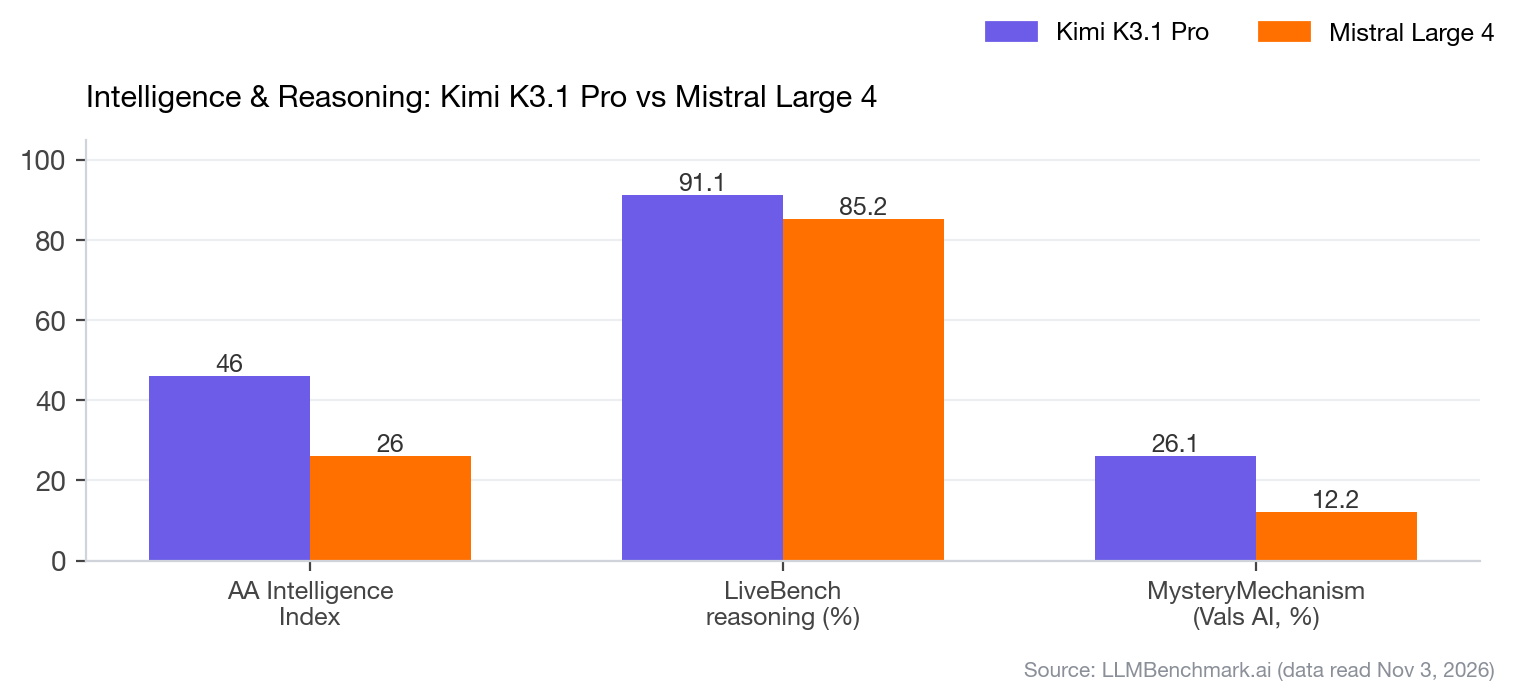
On the Artificial Analysis Intelligence Index v5.0, which combines evaluations of knowledge, document analysis, agent work, coding and science, Kimi scores 46 to Mistral's 26, a 20-point gap.
The individual tests agree. Kimi scores 91.1% on LiveBench reasoning against Mistral's 85.2%, and 26.1% on Vals AI's MysteryMechanism, a set of hard multi-step reasoning problems, against 12.2%. Kimi also scores 52.5% on Humanity's Last Exam in Artificial Analysis's run, where Mistral has no published result.
For work like comparing several company reports, spotting inconsistencies and building an investment case, those scores suggest Kimi will connect the pieces more reliably. Results still depend on the prompt, the reasoning setting and the test method, so check on your own documents.
Coding and agents
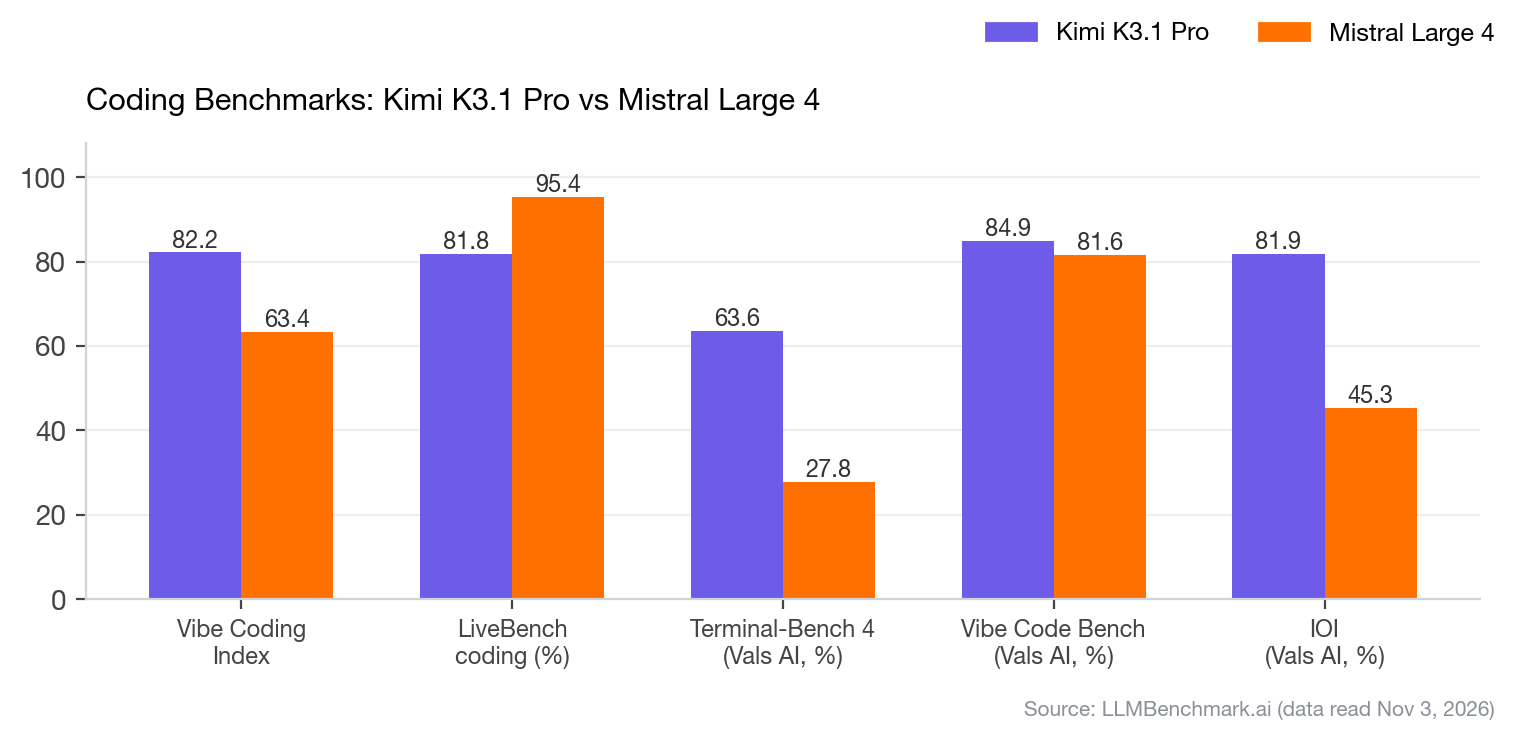
Kimi's coding lead is biggest on agent tasks, where the model has to work inside a real environment: read a codebase, run commands, read the errors and try again. On Vals AI's Terminal-Bench 4 run, Kimi scores 63.6% and Mistral 27.8%. On IOI, a competitive programming test, it's 81.9% to 45.3%. Kimi also leads the Vibe Coding Index, a composite of six public coding benchmarks, 82.2 to 63.4.
Mistral does win two boards: LiveBench coding, 95.4% to 81.8%, and LiveBench research, 79.7% to 77.9%. So it writes good code when the problem is well defined, and falls behind once the task turns into a long loop of tool calls and fixes.
The test setup also changes the numbers a lot. Mistral reports 41% on Terminal-Bench 4.0 with its own setup, well above Vals AI's 27.8%, and Moonshot reports 65.7% for Kimi with Claude Code. Compare numbers from the same harness, as the chart does.
Long context
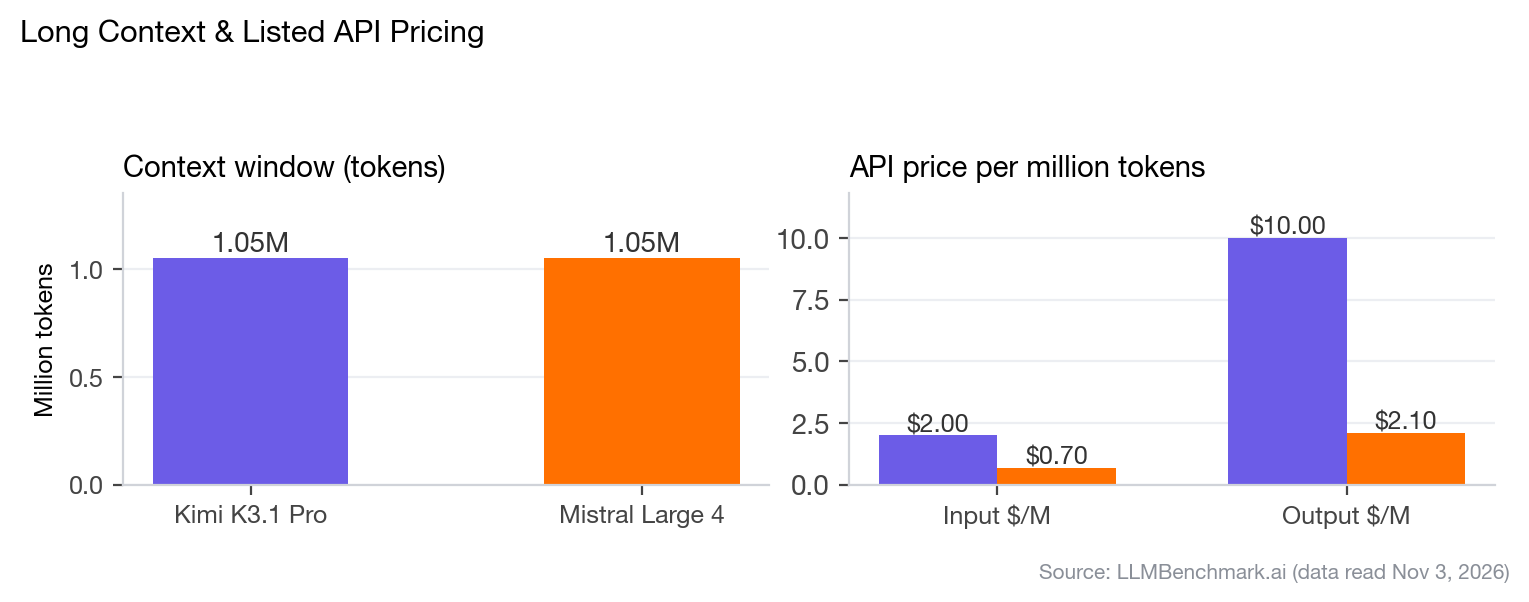
Both models accept about a million tokens, enough for a large codebase, a stack of contracts or months of conversation history. Neither has a published long-context retrieval score in this comparison, so the window size doesn't tell you which one actually finds the detail buried on page 300. If your app depends on long inputs, test retrieval on your own documents. One practical note: some third-party routes for Mistral cap the context lower, at around 512K, so check the provider you use.
Speed
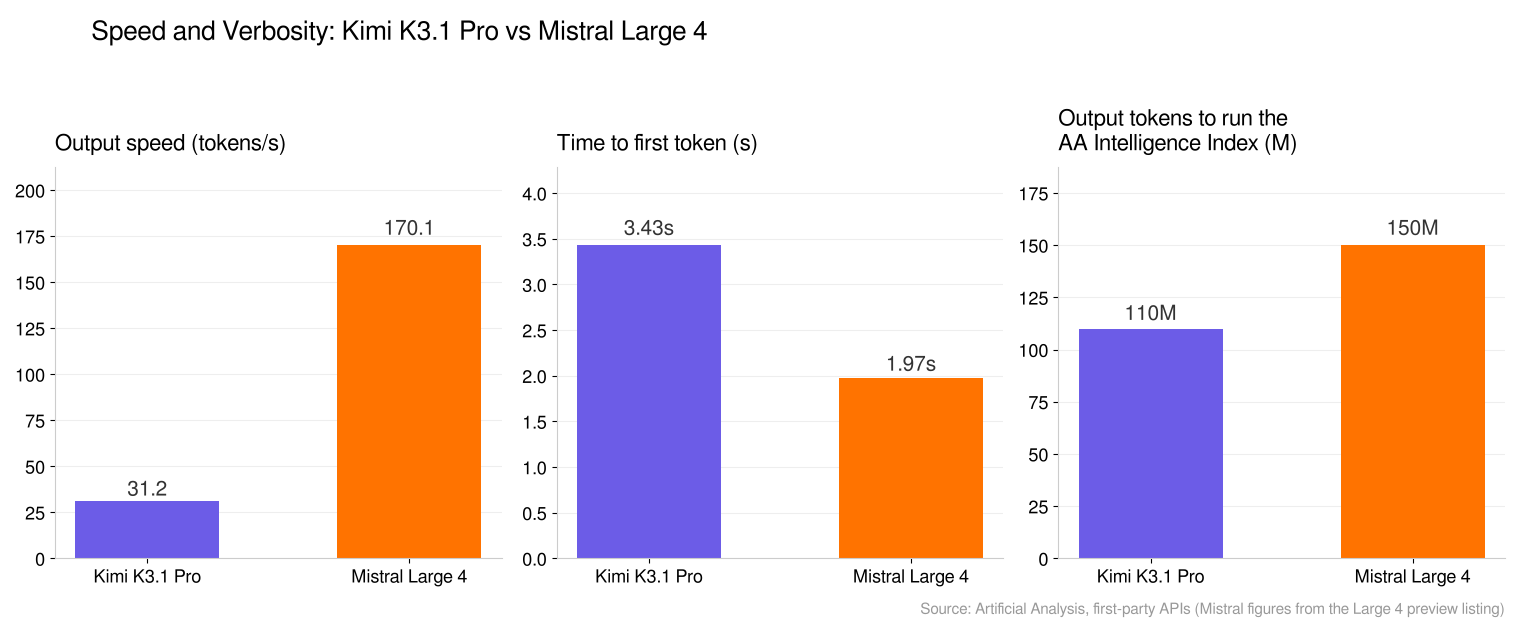
Speed is Mistral's clearest win. Artificial Analysis measures Mistral at 170.1 output tokens per second on its own API, with 1.97 seconds to the first token. Kimi runs at 31.2 tokens per second with 3.43 seconds to the first token. For a 1,000-token answer, that's roughly 8 seconds from Mistral against 35 seconds from Kimi.
If a person is waiting on the answer, as in a chat window, users will notice that difference. A background agent that runs overnight can live with it. Moonshot also sells a Highspeed version of K3.1 Pro that it says runs two to three times faster, at double the price ($4 / $20).
API cost
Kimi costs about 2.9 times as much as Mistral for input and 4.8 times as much for output. Take a workload of 100 million input tokens and 20 million output tokens:
| Input | Output | Total | |
|---|---|---|---|
| Mistral Large 4 | $70 | $42 | $112 |
| Kimi K3.1 Pro | $200 | $200 | $400 |
Mistral comes out about 72% cheaper. The gap holds across typical request sizes:
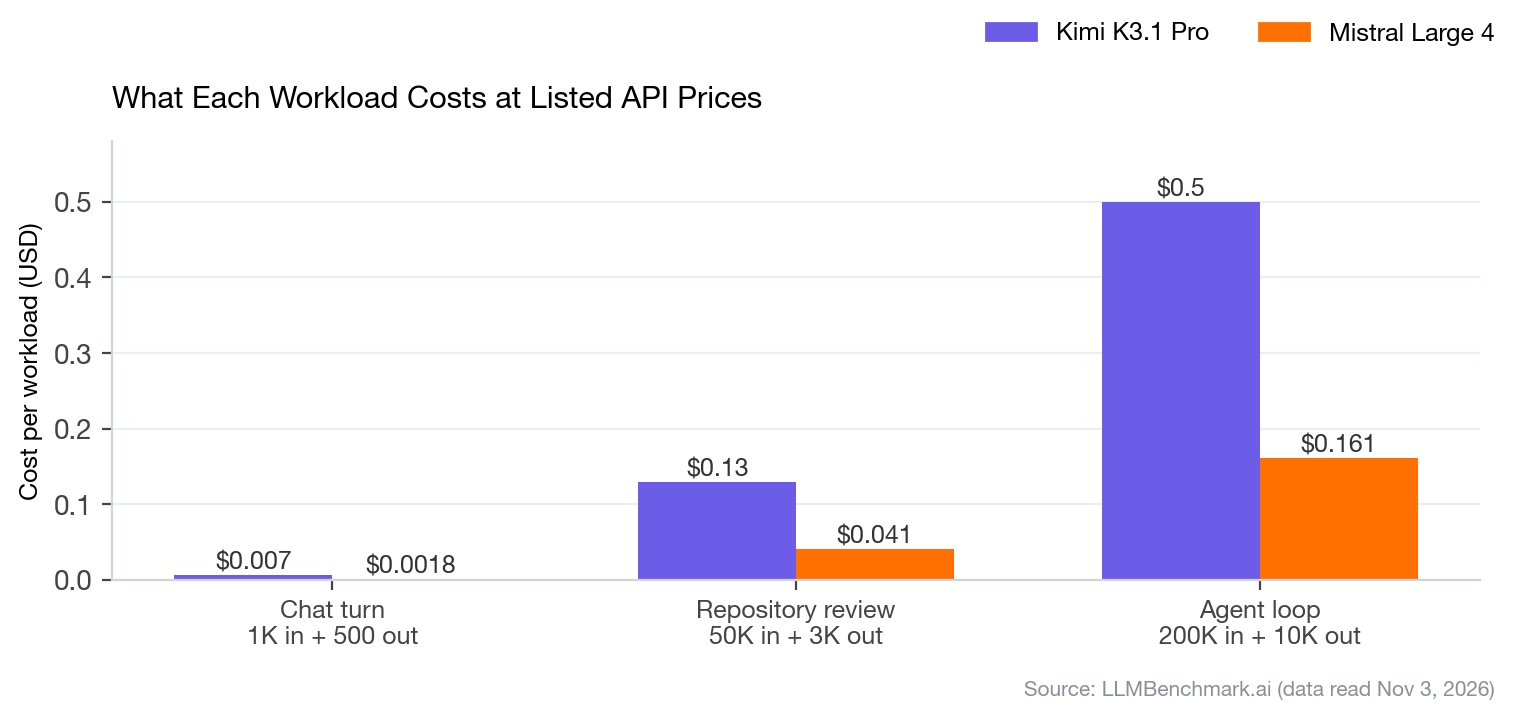
Mistral also writes more. It used about 150 million output tokens to run the Artificial Analysis Intelligence Index, against Kimi's 110 million. At list prices that comes to about $315 of output for Mistral and $1,100 for Kimi, so Mistral is about 3.5 times cheaper on the same tasks, a smaller gap than the 4.8 times its output price suggests. (The Mistral figure comes from Artificial Analysis's preview listing.)
Which one to choose
Start with Kimi K3.1 Pro when getting the task right matters more than the bill. A coding agent working through a whole repository is the clearest case, and so is multi-step automation where a failed run costs more than the tokens. Its lead on agentic coding and hard reasoning is big enough to show up in real work.
Start with Mistral Large 4 for anything a user waits on, and for high-volume pipelines where the price difference adds up quickly. It's also the only one of the two you can self-host today, which matters for data governance and EU residency.
You can also use both: route routine, latency-sensitive requests to Mistral and send the hardest reasoning and coding tasks to Kimi, then measure the cost of each successfully finished task on your own workload before you commit to either.
Run your own comparison on A2Agent
A2Agent gives you DeepSeek, GLM, Kimi, MiniMax, Qwen and other models behind one API key, with OpenAI-compatible and Anthropic-compatible endpoints. You can send the same prompts to several models, compare quality, latency and cost per finished task, and route each kind of request to the model that handles it best. See the Models page for current availability and prices. New accounts get $5 in free credit.
Sources
- Kimi K3.1 Pro vs Mistral Large 4 (LLMBenchmark.ai, data read November 3, 2026)
- Kimi K3.1 Pro: Intelligence, Performance & Price Analysis (Artificial Analysis)
- Mistral Large 4 Preview: Intelligence, Performance & Price Analysis (Artificial Analysis)
- Introducing Kimi K3.1 Pro (Kimi on X)
- Introducing Kimi K3.1 Pro (Moonshot AI)
- Introducing Mistral Large 4 (Mistral AI)
- Kimi K3.1 Pro review (eesel AI, Highspeed pricing)