Qwen4-Max Review: Benchmarks, Pricing and Where It Actually Fits
A2Agent Team · 2026-11-16T00:00:00Z
Alibaba released Qwen4-Max on November 16, 2026, five days after opening a preview. It's the new flagship of the Qwen family, built for reasoning, coding and agent work, and it takes text, images and video as input. Alibaba says it's the most capable Qwen model so far and that it cuts the average cost of a task by about 60% compared with Qwen3.8-Max.
Independent tests put it a step below the US flagships overall. It's cheaper than they are, though, and does well on a few kinds of professional work, finance in particular. Below are the specs, the third-party and official benchmarks, the price, and the jobs it suits.
Quick answer
- 2.4T-parameter mixture-of-experts model with about 71B active parameters per token, roughly 25% fewer than Qwen3.8-Max
- 1M-token context window, with text, image and video input and text output
- Price: $1.50 input and $4.50 output per million tokens internationally, ¥10 / ¥30 in China, with cached input at 5% of the input price
- Vals Index: 63.20%, #11 of 38 models and the top Chinese model on that index
- Artificial Analysis Intelligence Index: 43, #9 overall, behind Kimi K3.1 Pro (46)
- Leads Alibaba's comparison on DeepSWE, Agents' Last Exam, legal agent work and bioinformatics, and trails the US flagships on terminal coding, charts and video
- Weights are proprietary. Alibaba plans smaller open-weight Qwen4 models
Specs and features
Qwen4-Max is a sparse mixture-of-experts model with 2.4 trillion total parameters. It activates about 71 billion per token, plus a separate 328-billion-parameter N-gram embedding, according to Artificial Analysis. Alibaba says that's about 25% fewer active parameters than Qwen3.8-Max at the same overall size, and that in high-effort reasoning mode the model uses about 35% fewer tokens per task.
The context window is 1M tokens, enough for long contracts, research reports or a large codebase in one request. That's the input limit; the output limit is separate and smaller.
A thinking mode, switched on through the API, lets the model work through a problem before it answers. It helps with math, financial analysis, debugging and multi-step agent tasks, at the cost of more compute and slower replies.
Qwen4-Max reads text, images and video and writes text only, so it's for understanding visual material, such as answering questions about an image, pulling data out of a screenshot or analyzing a video, and can't generate images or video.
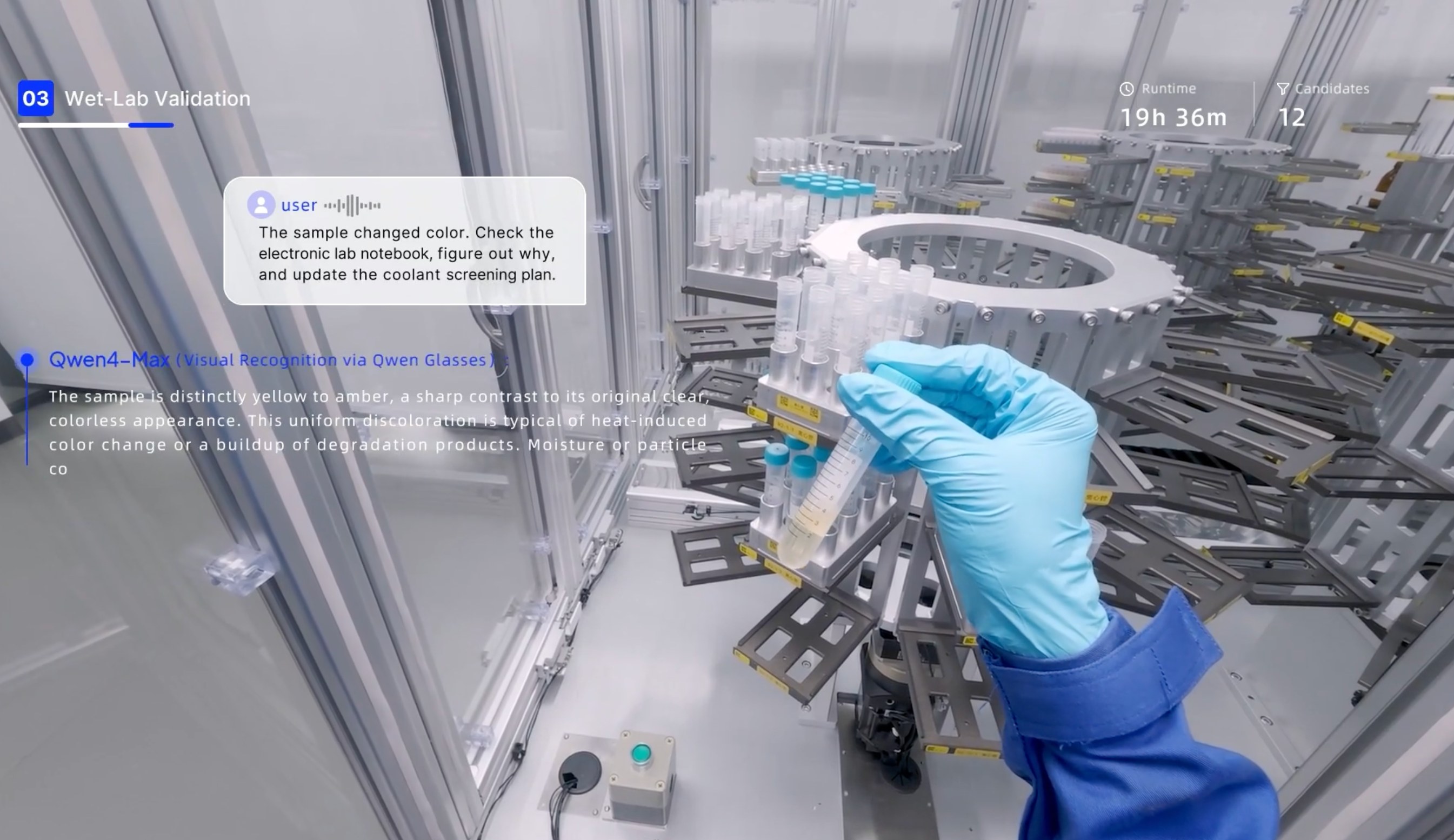
Alibaba's wet-lab demo, in the image above, shows how this works in an agent setting. A researcher wearing Qwen Glasses says only that the sample changed color and asks the model to check the lab notebook and update the plan. The model sees that the sample has turned from colorless to amber, reasons that heat exposure or a buildup of degradation products is the likely cause, and updates the coolant screening plan.
On the API side, Qwen4-Max supports function calling, web search, structured output, context caching, batch jobs, partial mode (continuing from a prefix you supply) and fine-tuning. You'll use function calling and structured output to connect it to agents, databases and automation pipelines, and caching and batch jobs to keep the bill down.
Third-party benchmarks
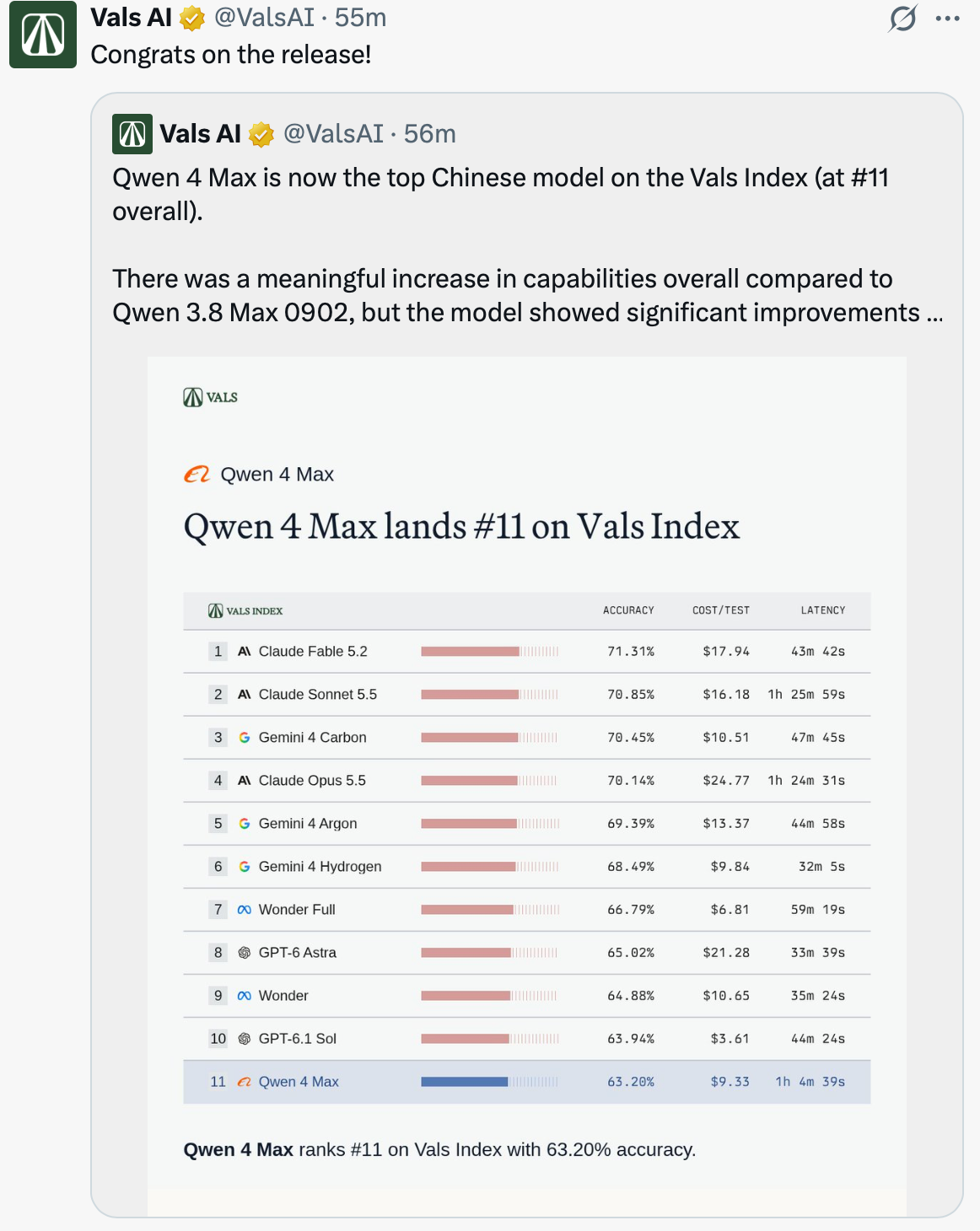
On the Vals Index v2.2, Qwen4-Max scores 63.20%, 11th of 38 models and the highest of any Chinese model Vals has tested. That's up 4.15 points from Qwen3.8-Max 0902's 59.05%.
The same leaderboard lists cost and speed. Qwen4-Max costs $9.33 per test, well under Claude Opus 5.5 ($24.77) and GPT-6 Astra ($21.28), though GPT-6.1 Sol scores slightly higher (63.94%) for $3.61. It's slow, though: at 1 hour 4 minutes per test, only Opus 5.5 and Sonnet 5.5 take longer among the top 11.
Artificial Analysis gives a less flattering ranking. Qwen4-Max scores 43 on its Intelligence Index, ninth overall, behind Claude Fable 5.2 (65), Gemini 4 Carbon (60), Claude Opus 5.5 (59), GPT-6 Astra (57), GPT-6.1 Sol (55) and Kimi K3.1 Pro (46). On that index, Kimi is the top Chinese model. Qwen4-Max is also wordy: it used 127 million output tokens on the index, against a median of 78.6 million, though its cost per task ($3.27) is still a third of Opus 5.5's ($10.04).
Vals AI's domain results show where it's strong and where it isn't:
| Area | Benchmark | Score | Rank |
|---|---|---|---|
| Finance | Vals Finance Index | 61.99% | 8th of 41 |
| Finance | Finance Agent v2.1 | 66.68% | 8th of 41 |
| Finance | Tax Agent Bench | 40.35% | 13th of 86 |
| Coding | Vibe Code Bench v1.1 | 86.66% | 15th of 129 |
| Coding | Terminal-Bench 4.0 | 48.48% | 15th of 65 |
| Legal | Vals Legal Index | 70.71% | 17th of 39 |
| Legal | Legal Research Bench | 41.35% | 33rd of 95 |
Finance is where it does best. It ranks eighth on both the finance index and the finance agent benchmark, which tests analysis and tool use, not just financial knowledge. On Vibe Code Bench, where models build working web apps from scratch, it scores 86.66%, behind Claude Fable 5.2 (93.77%), Gemini 4 Argon (91.91%) and DeepSeek V4.1 Flash 1017 (87.73%). Each full run cost $41.40 and took about 70 minutes, which is expensive for long coding tasks. Legal is mixed: decent on general legal knowledge, weak on deep legal research.
Official benchmarks
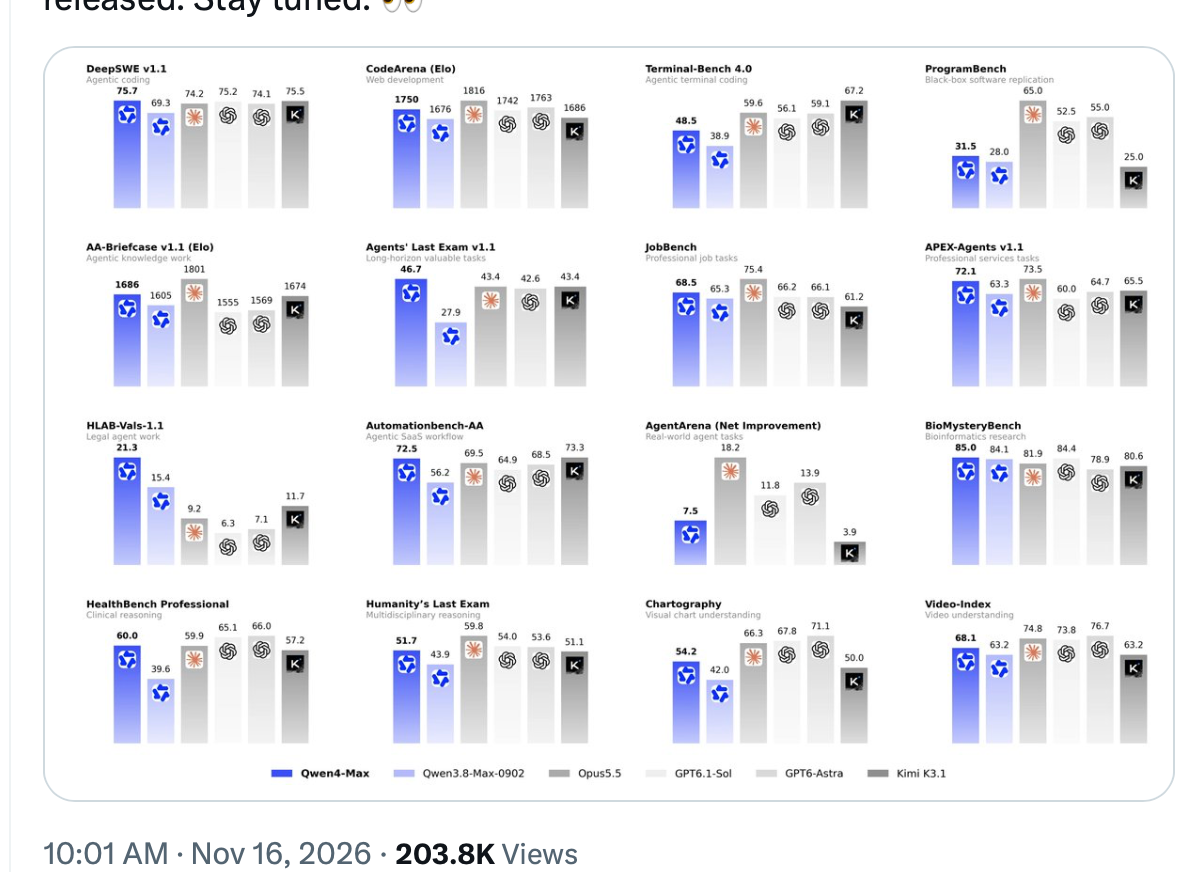
Alibaba published 16 benchmarks comparing Qwen4-Max with its predecessor and four rivals:
| Benchmark | Qwen4-Max | Qwen3.8-Max | Opus 5.5 | GPT-6.1 Sol | GPT-6 Astra | Kimi K3.1 |
|---|---|---|---|---|---|---|
| DeepSWE v1.1 | 75.7 | 69.3 | 74.2 | 75.2 | 74.1 | 75.5 |
| CodeArena (Elo) | 1750 | 1676 | 1816 | 1742 | 1763 | 1686 |
| Terminal-Bench 4.0 | 48.5 | 38.9 | 59.6 | 56.1 | 59.1 | 67.2 |
| ProgramBench | 31.5 | 28.0 | 65.0 | 52.5 | 55.0 | 25.0 |
| AA-Briefcase v1.1 (Elo) | 1686 | 1605 | 1801 | 1555 | 1569 | 1674 |
| JobBench | 68.5 | 65.3 | 75.4 | 66.2 | 66.1 | 61.2 |
| APEX-Agents v1.1 | 72.1 | 63.3 | 73.5 | 60.0 | 64.7 | 65.5 |
| HLAB-Vals 1.1 (legal agents) | 21.3 | 15.4 | 9.2 | 6.3 | 7.1 | 11.7 |
| AutomationBench-AA | 72.5 | 56.2 | 69.5 | 64.9 | 68.5 | 73.3 |
| BioMysteryBench | 85.0 | 84.1 | 81.9 | 84.4 | 78.9 | 80.6 |
| HealthBench Professional | 60.0 | 39.6 | 59.9 | 65.1 | 66.0 | 57.2 |
| Humanity's Last Exam | 51.7 | 43.9 | 59.8 | 54.0 | 53.6 | 51.1 |
| Chartography | 54.2 | 42.0 | 66.3 | 67.8 | 71.1 | 50.0 |
| Video-Index | 68.1 | 63.2 | 74.8 | 73.8 | 76.7 | 63.2 |
Qwen4-Max beats its predecessor on every row. Against the rivals, it leads on four: DeepSWE (narrowly, 75.7 against Kimi's 75.5), legal agent work on HLAB-Vals, bioinformatics on BioMysteryBench, and Agents' Last Exam, where it scores 46.7 against 43.4 for both Opus 5.5 and Kimi. It's second on APEX-Agents, AutomationBench, AA-Briefcase and JobBench.
It falls well behind on terminal coding, software replication, charts and video. On Terminal-Bench 4.0, Kimi K3.1 scores 67.2 and the US models 56 to 60, against Qwen4-Max's 48.5. On ProgramBench, Opus 5.5 scores more than double. Despite the multimodal pitch, Qwen4-Max's Chartography (54.2) and Video-Index (68.1) scores trail all three US models by 6 to 17 points. On AgentArena, which measures real-world agent tasks, it scores 7.5 against Opus 5.5's 18.2.
The Terminal-Bench number is the most trustworthy one in the chart. Alibaba reports 48.5 and Vals AI measured 48.48% independently.
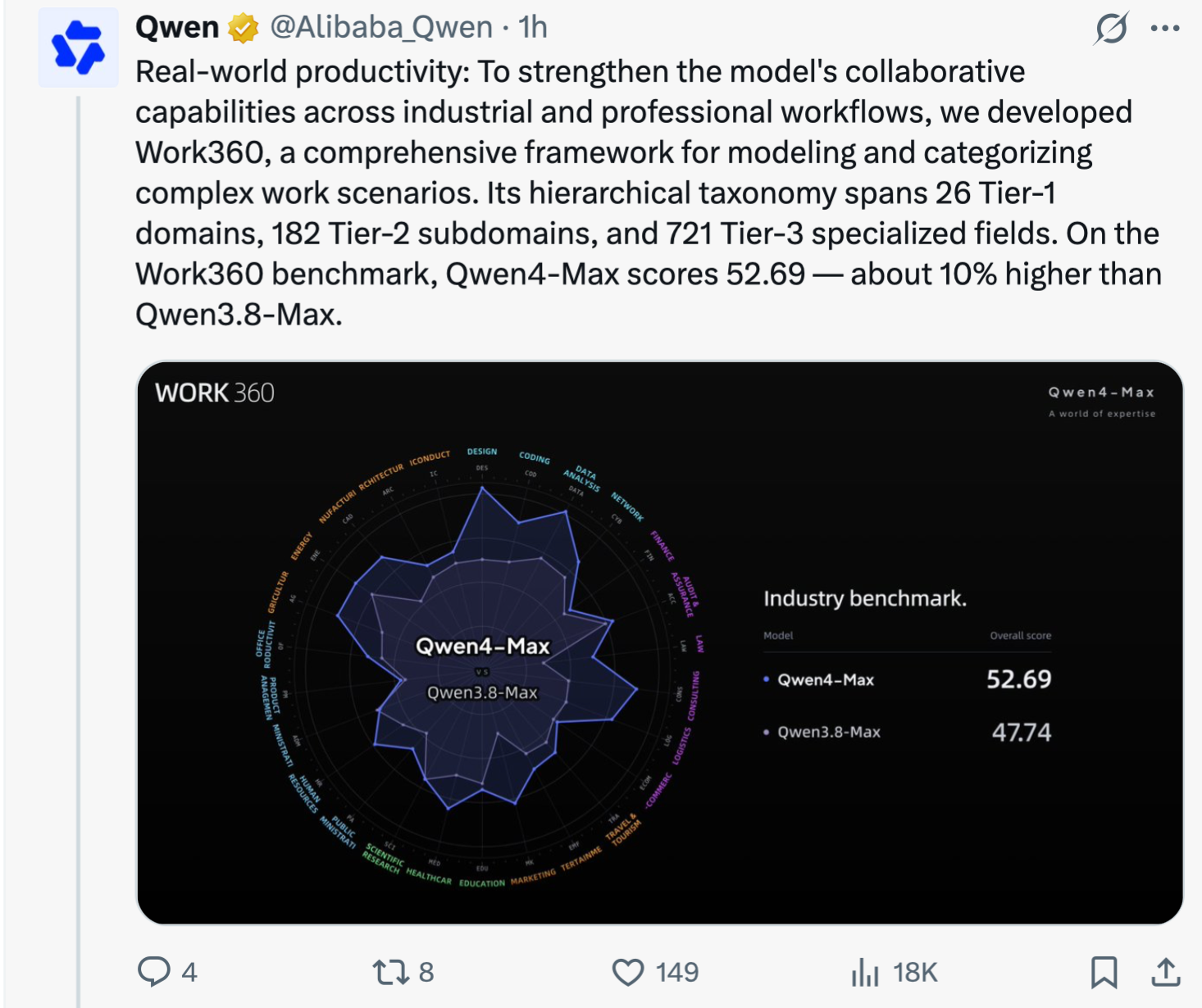
Alibaba also built its own benchmark, Work360, which covers professional work across 26 domains, 182 subdomains and 721 specialized fields. Qwen4-Max scores 52.69, about 10% above Qwen3.8-Max's 47.74, and Artificial Analysis notes that the cost per Work360 task fell from $4.43 to $1.67. Alibaba designed Work360, chose the prompts and ran the scoring, so treat it as a comparison with the previous Qwen rather than a ranking against other companies' models.
Pricing
| Per 1M tokens | International (USD) | China (CNY) |
|---|---|---|
| Input | $1.50 | ¥10 |
| Output | $4.50 | ¥30 |
| Cached input | $0.075 | ¥0.5 |
| Batch input / output | n/a | ¥5 / ¥15 |
Output costs three times as much as input, so reasoning-heavy and generation-heavy work is driven by output tokens. Cached input costs 5% of normal input, which matters a lot for agents that resend the same system prompt, rules or documents on every call. At the Chinese price, a request with 10,000 input tokens and 5,000 output tokens costs ¥0.25.
For comparison, GPT-6.1 Sol and Kimi K3.1 Pro both list at $2 / $10, and Claude Opus 5.5 at $4 / $20. Qwen4-Max is the cheapest of these per token, but it also writes a lot more than average, so the fair comparison is the cost of a finished task.
You can use it through Qwen Cloud's API and Token Plan, and in Alibaba's QwenWork and QwenStudio apps.
Where it fits
Qwen4-Max suits complex reasoning over a lot of material. In finance, that means data analysis, reading reports and multi-step workflows. In software, code generation, scaffolding and debugging. In enterprise work, the 1M-token window makes it a good fit for long contracts, research reports and large internal documents.
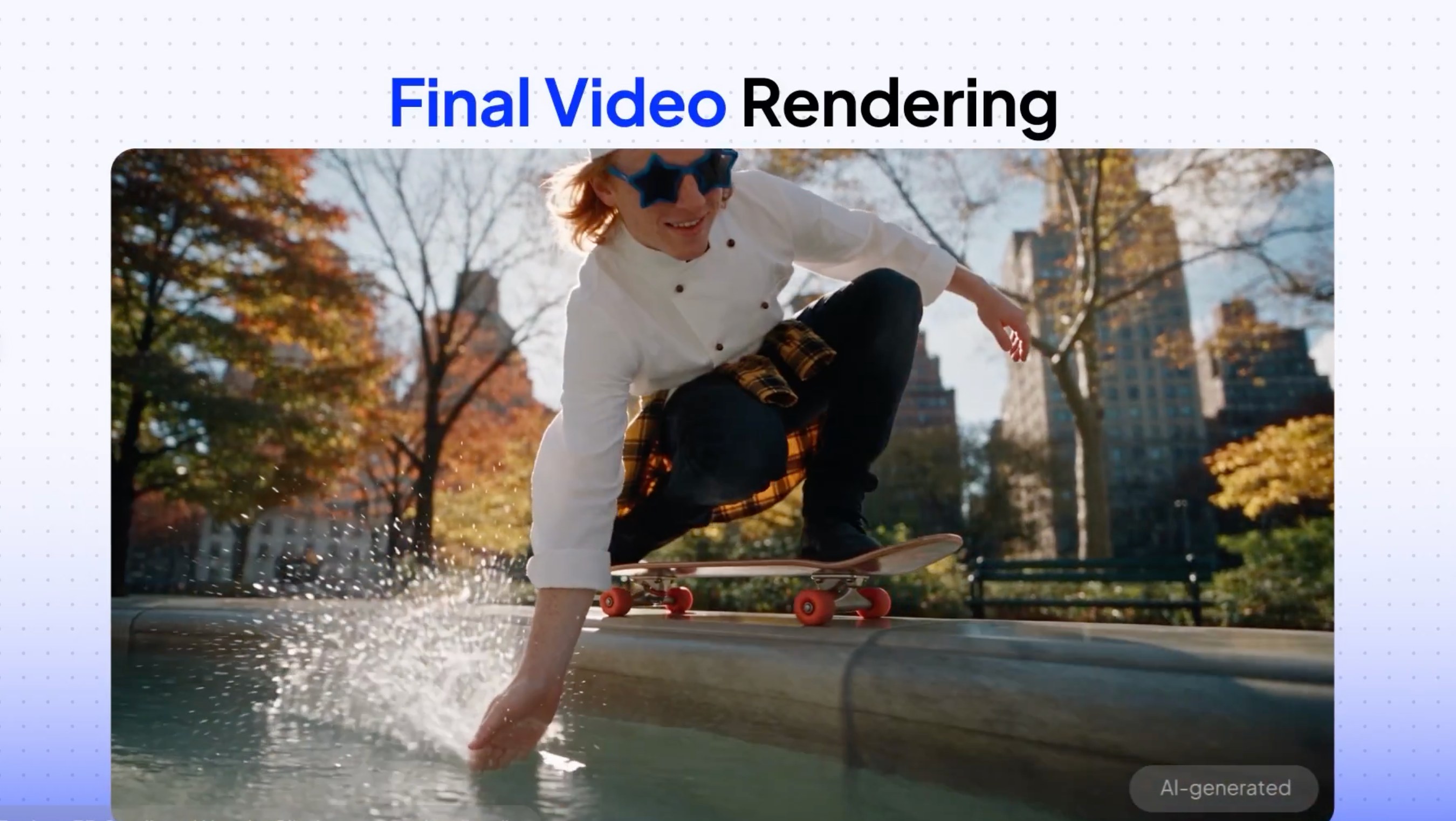
It's also being used to coordinate content pipelines. In WonderClip's 3D video demo, Qwen4-Max breaks down the script, plans the storyboard and schedules the steps, and separate video models render the frames.
It's a poor fit for simple classification, real-time chat where latency matters, and high-volume work where cost matters most. Those are better handled by cheaper, faster models, with only the hard tasks routed to Qwen4-Max.
Safety
Alibaba says it added checks for code injection, memory-safety flaws and broken access control to its software engineering training, kept defensive security material in the training data while filtering out offensive attack content, and did dedicated safety work on chemical, biological, radiological and nuclear risks. According to Reuters, Alibaba's internal testing found "no evidence of significant high-risk capabilities."
Bottom line
Qwen4-Max is a clear step up from Qwen3.8-Max and the strongest Chinese model on the Vals Index. Its best results are in finance agents, legal agent work, long professional tasks and agentic coding on DeepSWE, at a lower token price than the US flagships. Its weak spots are just as clear: it's slow, it writes a lot, it trails on terminal coding and on chart and video understanding, and on Artificial Analysis's index it still sits behind Kimi K3.1 Pro.
On an API platform, it's a flagship reasoning model to reach for on hard tasks. Pair it with a fast, cheap model for routine requests and route only the hard reasoning and long-document work to Qwen4-Max.
Qwen on A2Agent
A2Agent carries Qwen models alongside DeepSeek, GLM, Kimi and MiniMax, all through one API key with OpenAI-compatible and Anthropic-compatible endpoints. See the Models page for current availability and prices. New accounts get $5 in free credit.
Sources
- Vals Index (Vals AI) and the Vals AI post on X announcing Qwen 4 Max at #11, November 16, 2026
- Qwen4-Max announcement and benchmark chart (Qwen on X, November 16, 2026)
- Qwen4-Max: Your New Teammate Has Arrived (Qwen)
- Alibaba says Qwen4-Max cuts task costs by 60%, boosts cyber safeguards (Business Standard, November 16, 2026)
- Alibaba's giant Qwen4-Max model trails Claude, GPT and Moonshot AI (Trending Topics, Artificial Analysis data, November 16, 2026)
- 2.4 万亿参数阿里通义千问 Qwen4-Max 正式上线 (IT之家)
- Alibaba launches Qwen4-Max with lower API prices (The Defiant)