Qwen4-Max vs Kimi K3.1 Pro: Benchmarks, Coding Performance and API Pricing Compared
A2Agent Team · 2026-11-17T00:00:00Z
Moonshot AI launched Kimi K3.1 Pro on October 23, 2026, and opened its weights on Hugging Face in early November. On November 16, Alibaba released Qwen4-Max, the flagship of its new Qwen4 family, and kept the weights closed.
On paper they look alike. Both have a 1M-token context window, both are aimed at reasoning, coding and agent work, and both launched with charts showing them close to the best US models. Underneath, they're different bets. Alibaba built Qwen4-Max around multimodal input and a low price. Moonshot spent its effort on reinforcement learning for coding and long agent tasks, then released the weights. Their strengths overlap less than you'd expect, so the choice between them is mostly about the job.
Specs
| Qwen4-Max | Kimi K3.1 Pro | |
|---|---|---|
| Developer | Alibaba | Moonshot AI |
| Architecture | Sparse MoE, 2.4T total, plus a 328B N-gram embedding | MoE, 2.8T total |
| Active parameters | 71B per token | 104B per token |
| Context window | 1M tokens | 1M tokens (1,048,576) |
| Input | Text, images and video | Text and images; Moonshot also cites video understanding |
| Weights | Closed, API only | Open, under the Kimi K3.1 Pro License |
| Price per 1M tokens (input / output) | $1.50 / $4.50 | $2.00 / $10.00 |
| Cached input per 1M tokens | $0.075 | $0.20 |
Qwen4-Max runs 71B of its 2.4T parameters per token, about 25% fewer active parameters than Qwen3.8-Max, which is part of how Alibaba says it cut the average cost per task by about 60%. Kimi runs 104B per token, close to half again as many, and that shows up in its price.
The bigger difference for many teams is the weights. Kimi K3.1 Pro's are on Hugging Face as moonshotai/Kimi-K3.1-Pro, about 1.56 TB. The license allows commercial use, modification and self-hosting, with two conditions: a model-as-a-service business with more than $20 million in revenue over 12 months needs a separate agreement with Moonshot, and very large products (over 100 million monthly users or $20 million in monthly revenue) have to show "Kimi K3.1-Pro" in their interface. If you need to run the model on your own hardware, for compliance, fine-tuning or cost at scale, Kimi is the only option of the two.
Benchmarks
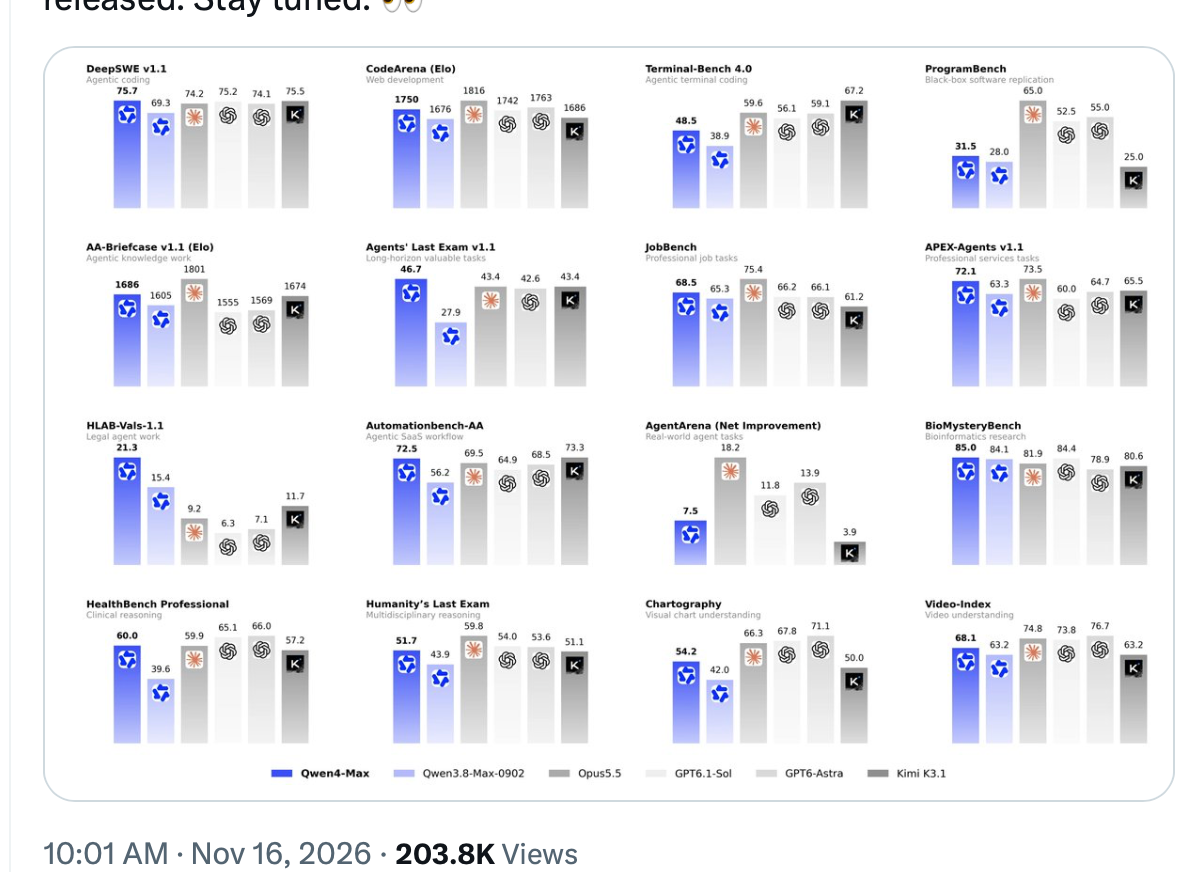
The most complete head-to-head so far is Alibaba's own launch chart, which includes Kimi K3.1. The rows where the two differ most:
| Benchmark | Qwen4-Max | Kimi K3.1 |
|---|---|---|
| Terminal-Bench 4.0 (terminal coding) | 48.5 | 67.2 |
| DeepSWE v1.1 (agentic coding) | 75.7 | 75.5 |
| HLAB-Vals 1.1 (legal agents) | 21.3 | 11.7 |
| BioMysteryBench (bioinformatics) | 85.0 | 80.6 |
| Agents' Last Exam (general agents) | 46.7 | 43.4 |
| APEX-Agents v1.1 | 72.1 | 65.5 |
| AutomationBench-AA | 72.5 | 73.3 |
| Humanity's Last Exam | 51.7 | 51.1 |
| Chartography (chart understanding) | 54.2 | 50.0 |
Scores from Alibaba's Qwen4-Max launch comparison. Moonshot reports 65.7 for Kimi K3.1 Pro on Terminal-Bench 4.0, so the gap there is about 17 to 19 points either way.
Kimi is far ahead on terminal coding, the test closest to real engineering work in a shell. Qwen4-Max leads on professional work. It scores almost twice Kimi's result on legal agent tasks (21.3 to 11.7), and it's ahead on bioinformatics, APEX-Agents and Agents' Last Exam. On DeepSWE, the agentic coding benchmark, they're tied, and on automation and Humanity's Last Exam they're within a point.
Alibaba made this chart, so it picked the tests. Independent rankings disagree with each other. On the Artificial Analysis Intelligence Index, Kimi leads 46 to 43. On the Vals Index, Qwen4-Max scores 63.20%, the highest of any Chinese model Vals has tested.
Independent testing also shows costs the launch chart leaves out. Artificial Analysis found that Qwen4-Max is verbose: it used 127 million output tokens to run the index, against a median of 78.6 million and Kimi's 110 million. Vals AI measured more than an hour per test run. Kimi is slow in its own way, at about 31 output tokens per second on Moonshot's API, though Moonshot sells a Highspeed version for twice the price.
Kimi has also improved its accuracy. On Moonshot's hallucination benchmark, 5.4% of K3.1 Pro's factual claims contain an error without tools, and 8.3% on the hard set with tools, down from 23.4% for Kimi K3.
Pricing
At list price, Qwen4-Max is 25% cheaper on input and 55% cheaper on output. For a request with 1 million input tokens and 200,000 output tokens:
| Qwen4-Max | Kimi K3.1 Pro | |
|---|---|---|
| Input (1M tokens) | $1.50 | $2.00 |
| Output (200K tokens) | $0.90 | $2.00 |
| Total | $2.40 | $4.00 |
Qwen4-Max comes out 40% cheaper on that request. Its verbosity cuts into that lead on real tasks, since output is where most of the money goes, but not by much. On the Artificial Analysis index runs, Qwen4-Max's output came to about $570 at list price and Kimi's to about $1,100, so Qwen4-Max was still roughly half the cost.
Caching widens the gap for agents. Qwen4-Max charges $0.075 per million cached input tokens against Kimi's $0.20, and agent pipelines resend the same system prompt, rules and documents on every call. If most of your input is cached, Qwen4-Max's input cost is less than half of Kimi's. Kimi's batch API, at 60% of standard price, helps for offline work.
The number that matters is still the cost of a finished task on your own workload. A cheaper model that needs two attempts at a terminal task can cost more than Kimi doing it once.
Which to pick
Pick Kimi K3.1 Pro for coding agents, terminal-heavy engineering and long multi-step execution, or when you need open weights for self-hosting, fine-tuning or compliance audits.
Pick Qwen4-Max for legal, financial or research documents at scale, for pipelines that need image and video understanding, and for high-volume work where token price drives the budget.
Many teams will want both, with a router that sends hard coding jobs to Kimi, document analysis to Qwen, and routine requests to a cheap, fast model.
Qwen and Kimi on A2Agent
A2Agent carries Qwen and Kimi models alongside DeepSeek, GLM and MiniMax, behind one API key with OpenAI-compatible and Anthropic-compatible endpoints. Switching between models is a change to the model ID, with no new SDK or credentials. The Models page lists each model's provider, context window and current price, so you can check availability and run both on your own tasks. New accounts get $5 in free credit.
Sources
- Qwen4-Max launch chart (Qwen on X, November 16, 2026)
- Alibaba says Qwen4-Max cuts task costs by 60% (Business Standard)
- Alibaba's giant Qwen4-Max model trails Claude, GPT and Moonshot AI (Trending Topics, Artificial Analysis data)
- Vals Index (Vals AI)
- Introducing Kimi K3.1 Pro (Moonshot AI)
- Kimi K3.1 Pro: Intelligence, Performance & Price Analysis (Artificial Analysis)
- Kimi K3.1 Pro open weights: download size, license, scores (Nowrap)
- Kimi K3.1 Pro open weights land on Hugging Face (AILog)